Quick Summary
Understanding the physical constraints of modern vrams is essential for maintaining a high-performance workstation. These memory modules operate at incredible frequencies, generating significant heat that often goes unmanaged by standard system drivers. When the workload increases, the thermal density within these small chips can quickly exceed safe operating limits, leading to performance degradation.
The Thermal Reality of Modern VRAM
The technical debate surrounding gddr6x vs gddr6 often focuses on bandwidth, but the thermal implications are equally important. While the 6X standard offers superior data rates through PAM4 signaling, it also consumes more power and generates more heat. Choosing between these standards requires a deep understanding of your cooling system's ability to handle sustained thermal loads.
High-performance gddr6x modules are frequently found in flagship graphics cards and professional laptops. These chips are designed for maximum throughput, but their power density is significantly higher than previous generations. Managing this heat is a constant challenge for engineers, especially in compact chassis where airflow is naturally restricted by the physical design.
In contrast, standard gddr6 memory is often used in mid-range hardware due to its balanced efficiency and thermal profile. While it may offer lower peak bandwidth, it is generally easier to cool during long sessions. However, even these more efficient chips can encounter thermal bottlenecks when pushed to their absolute limits by modern AI models.
Effective vram cooling requires more than just high fan speeds; it requires a strategic approach to heat dissipation. In many modern laptops, the memory modules share heat pipes with the GPU core, leading to rapid thermal saturation. When the cooling assembly reaches its maximum capacity, the memory chips have nowhere to vent their energy.
"When the cooling assembly reaches its maximum capacity, the memory chips have nowhere to vent their energy."
Many users attempt to solve these issues by installing a secondary vram cooler or using cooling pads. While physical modifications can help, they often fail to address the root cause of the heat: the continuous electrical activity within the silicon. A more integrated approach that combines physical cooling with intelligent software management is usually required for stability.
While you cannot literally perform a vram download to increase your physical hardware capacity, you can certainly optimize how your existing memory handles data. Software-based management allows you to control the duty cycle of the hardware, ensuring that the memory modules have sufficient time to cool down between intensive computational cycles.

Know your VRAM Thermal Limits
Download the 2026 Reference Chart for RTX 30/40/50 Series.
Pulse Throttling: Software-Defined Stability
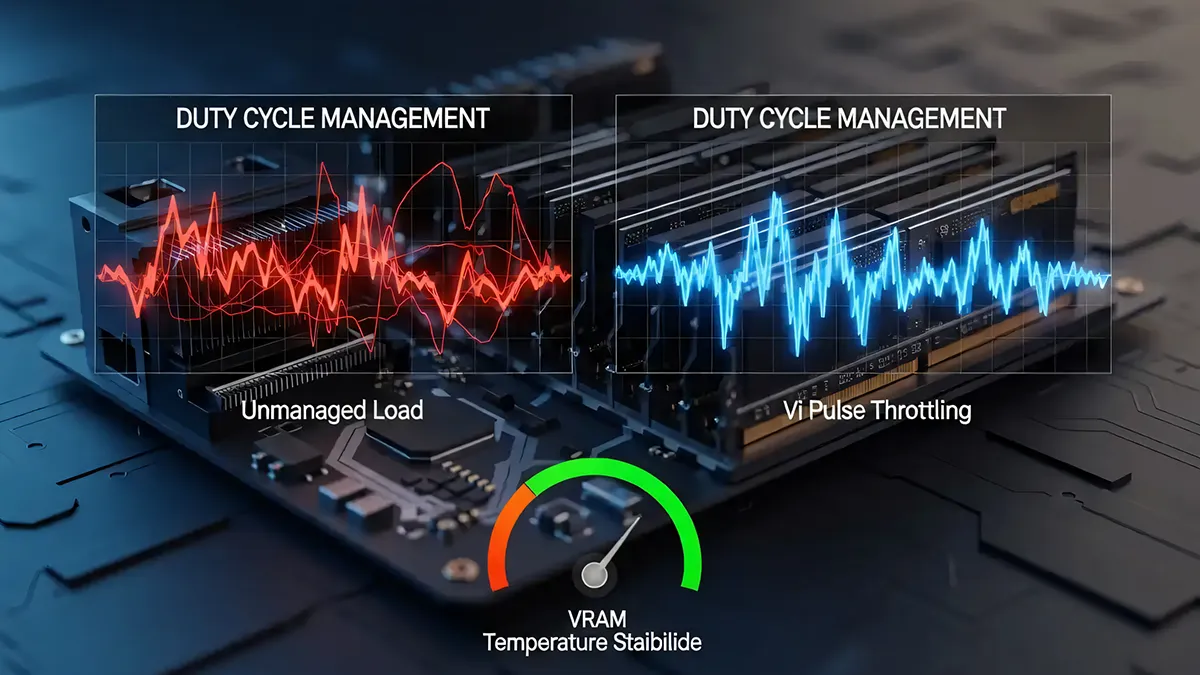
The Pulse Throttling duty cycle operates on this fundamental engineering concept, introducing micro-pauses to manage the hardware's peak power state. This approach is exceptionally effective for mitigating thermal soak during long rendering or generation tasks. By modulating the workload at the software level, you can maintain stable temperatures without invasive hardware modifications. Introducing micro-suspensions GPU workloads allows the thermal assembly to clear heat faster than it accumulates. These pauses are measured in milliseconds, making them virtually invisible to the user while providing significant thermal relief to the hardware. This proactive strategy ensures that your system remains responsive and stable even under the most demanding conditions.
Managing laptop VRAM overheating is a primary concern for mobile professionals who cannot easily upgrade their cooling hardware. Laptops lack the massive heatsinks found in desktop rigs, making them far more susceptible to thermal throttling. Adopting a software-defined management layer is the most practical way to safeguard your hardware's longevity and performance.
During sustained workloads VRAM modules stay at peak utilization for hours, leading to a persistent heat soak effect. Standard firmware is often too reactive, waiting for a crisis before intervening with a blunt and aggressive throttle. Proactive management ensures that your hardware stays within a safe operating range throughout the entire duration of your project. Precise VRAM temperature control is the foundation of a reliable professional environment. By monitoring the memory junction in real-time, you can intervene before the hardware is forced into survival mode. This level of granularity allows you to maintain maximum throughput without the risk of sudden, unpredictable performance drops that ruin productivity.
Ensuring system stability VRAM requires a deep understanding of how your operating system schedules compute tasks. By optimizing this scheduling, you can prevent the "Yo-Yo" effect where the system constantly toggles between full speed and emergency cooling. A stable thermal profile is the key to predictable results in high-stakes professional environments.
The ultimate goal of any thermal strategy is to achieve consistent performance across all your daily tasks. Whether you are generating complex AI art or rendering 3D animations, you need your hardware to perform predictably. Software-level modulation provides the stability required to meet deadlines without worrying about hardware-induced delays or system crashes.
VRAM Shield provides the advanced tools necessary to manage these complex thermal environments confidently. By utilizing its proprietary Smart Throttling technology, the software intelligently calculates the optimal duty cycle for your specific hardware configuration. This ensures that you get the most out of your investment while maintaining a professional and stable workstation.
Don't let unmanaged heat compromise your system's stability or your hardware's long-term health. Take direct, professional control over your hardware's thermal performance and ensure consistent output during your most demanding tasks. Explore the professional-grade monitoring and management tools in VRAM Shield by choosing your plan today.