Quick Summary
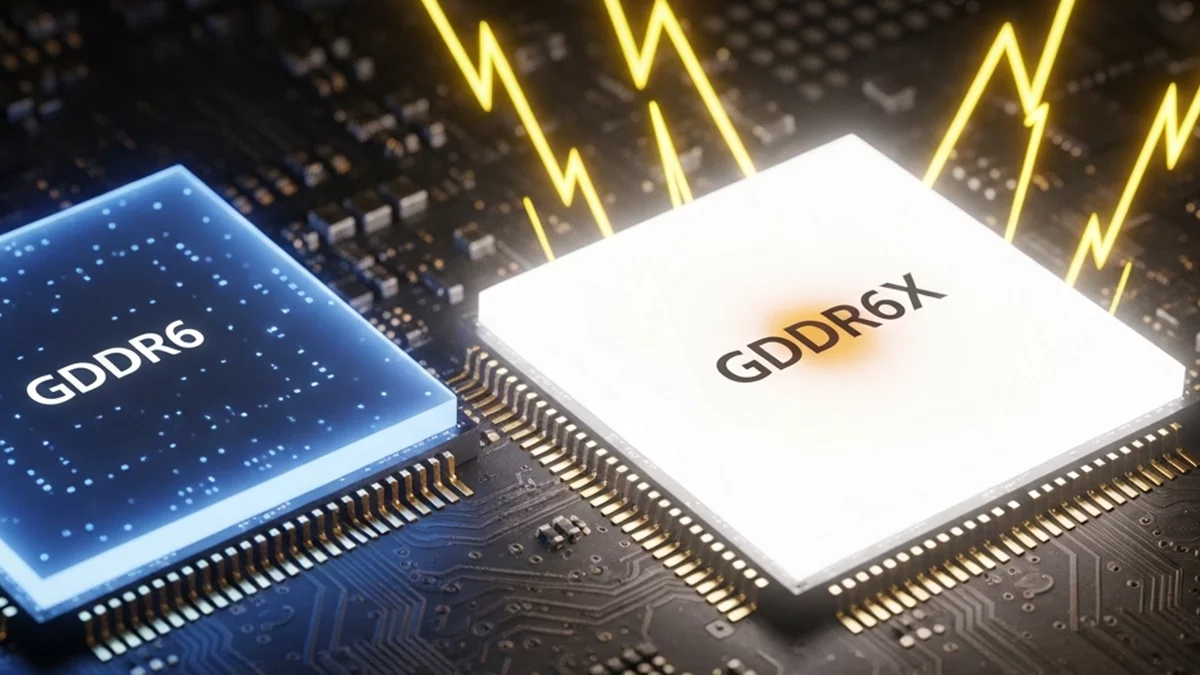
When looking at a laptop GPU buying guide in 2026, the type of memory often takes a backseat to the core count. However, for AI developers and hardcore gamers, the choice between GDDR6 and GDDR6X can significantly impact thermal performance. Understanding the GDDR6X thermal penalty is essential before making a purchasing decision.
Voltage Differences: 1.35V vs 1.1V
One of the hidden reasons for GDDR6X's heat is its operating voltage. While standard GDDR6 runs at a more efficient 1.1V to 1.25V, GDDR6X often requires up to 1.35V to maintain its extreme bandwidth. This 20% increase in voltage results in a nearly 40% increase in heat generation due to the physics of power dissipation (P=IV). In a laptop, this extra 10-15 Watts of heat can impact overall system thermals.
The PAM4 Revolution and Its Cost
GDDR6X uses PAM4 signaling. This allows it to transmit twice as much data per clock cycle as standard GDDR6. However, this comes at a cost. The VRAM power consumption of GDDR6X is significantly higher, often drawing up to 35-40W just for the memory array in high-end laptops. This creates a "thermal wall" where heat is generated by the GDDR6X but cannot escape to the radiator efficiently.
The Heat Density Problem
Standard GDDR6 is efficient and runs relatively cool (70-85°C). GDDR6X, due to its signaling complexity, has a much higher heat density. In the cramped chassis of a laptop, this heat can become a bottleneck, leading to the NVIDIA memory throttling issues we see in the RTX 4090 mobile variants. This explains why VRAM overheats in modern laptops despite adequate cooling for the GPU core.
The Future: GDDR7
As we look toward the horizon, GDDR7 is set to replace GDDR6X. While it promises even higher speeds, it also introduces new cooling challenges. Early data suggests that the thermal management strategies we use today, like our unique Pulse Throttling Technology, will be even more critical for the next generation of GPUs.

Know your VRAM Thermal Limits
Download the 2026 Reference Chart for RTX 30/40/50 Series.
Is the Speed Worth the Heat?
The bandwidth jump is impressive, but for many AI tasks like Stable Diffusion, the bottleneck is often the thermal limit, not the raw bandwidth. If your GDDR6X memory hits 105°C and throttles, it may perform similarly to a well-cooled GDDR6 card. This is the "Thermal Paradox" of modern high-end laptops.
Don't let marketing numbers blind you to the thermal reality. Manage your GDDR6X thermals effectively today. Check our PRO features. For practical guidance on addressing these thermal challenges, see The Ultimate Undervolting Guide for NVIDIA Laptops.