Quick Summary
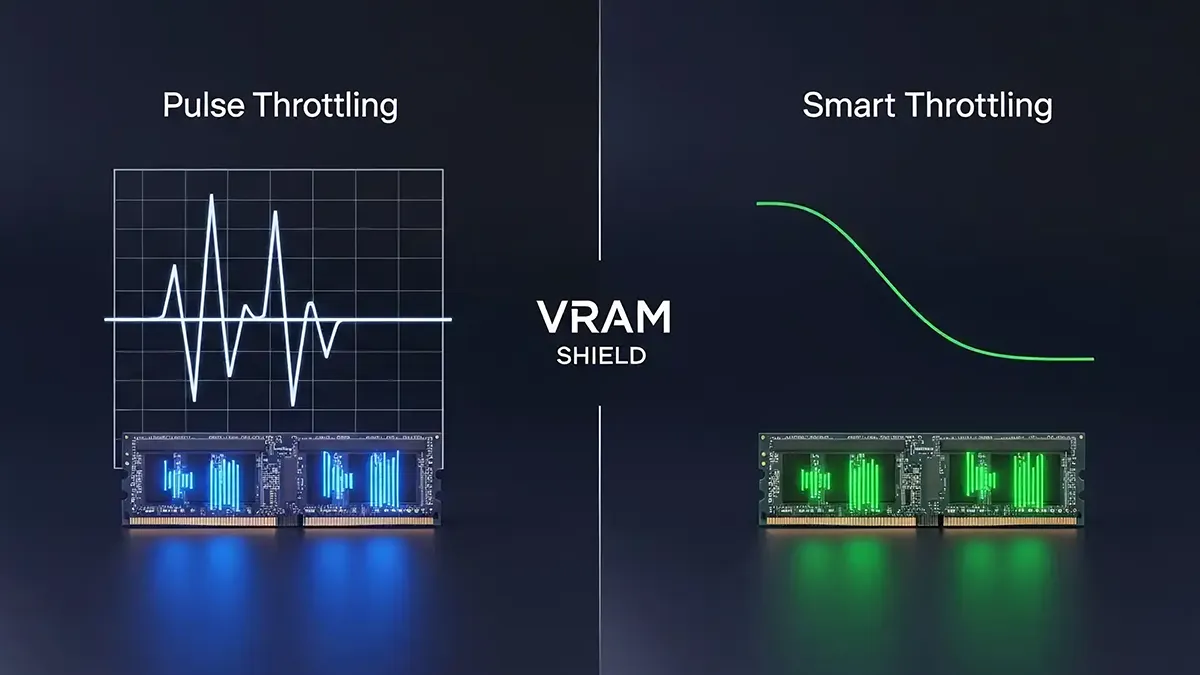
VRAM Shield offers two distinct methodologies for advanced VRAM temperature control: Pulse Throttling and Smart Throttling. While both rely on process scheduling GPU to mitigate heat density, they differ significantly in how they modulate the workload.
Choosing the right approach depends on your specific hardware, the intensity of your tasks, and your need for dynamic thermal responsiveness, ensuring optimal VRAM Shield thermal management. Pulse Throttling forms the foundation of our thermal management system.
It employs a fixed duty cycle to introduce micro-suspensions in GPU workloads. For example, setting a 10% pulse suspends the target process for 100ms every second. This consistent "breathing room" allows memory modules to dissipate heat faster than it accumulates.

Know your VRAM Thermal Limits
Download the 2026 Reference Chart for RTX 30/40/50 Series.
For users who require more granular VRAM temperature control, the Professional version introduces Smart Throttling. Instead of a fixed cycle, this method utilizes a smart controller VRAM to dynamically adjust the suspension duration.
Smart Throttling Benefits
Dynamic Thermal Response
Smart Throttling's reactive and precise adjustments prevent the performance "yo-yoing" often associated with simpler threshold-based management, ensuring hardware stability AI and consistent performance.
Our advanced throttling methods offer clear advantages over traditional GPU undervolting 2026 techniques. Undervolting, while beneficial for power efficiency, often fails to address the dynamic thermal spikes specific to VRAM under intense loads.
Both methodologies offered by VRAM Shield are designed to provide unparalleled hardware stability AI and consistent performance for demanding tasks. Explore the professional-grade monitoring and management tools in VRAM Shield by choosing your plan today.