Quick Summary
For years, enthusiasts have relied on undervolting as the primary method for GPU thermal management. However, as we enter 2026, the complexity of NVIDIA's clock management algorithms and the extreme sensitivity of GDDR6X memory have made traditional methods less predictable for some users. It's time to compare the classic approach with the innovative Pulse Throttling method. For those unfamiliar with the underlying VRAM challenges, see Why VRAM Overheats in Modern Laptops?
The Silicon Lottery Explained
Every GPU chip is unique. Some can run at low voltages with high stability, while others require more power just to function. This is the "Silicon Lottery." Traditional undervolting requires finding these limits. If you set your voltage too low, your system may become unstable during a heavy render, potentially interrupting hours of work. VRAM Shield mitigates this by managing load, not voltage. To understand the thermal differences between memory types, see GDDR6 vs GDDR6X: The Thermal Reality.

Know your VRAM Thermal Limits
Download the 2026 Reference Chart for RTX 30/40/50 Series.
"Traditional undervolting is a static solution to a dynamic problem. It forces the hardware into a narrow voltage window that may not be stable across all compute workloads."
The Risks of Undervolting in 2026
While effective in the hands of experts, undervolting risks in 2026 have increased due to tighter factory tolerances. Modern RTX cards use "transient spikes" of power that MSI Afterburner curves often fail to account for. A slight miscalculation can lead to:
- Unpredictable system instability (BSOD) during critical AI renders.
- Memory controller instability, which is often harder to detect than core crashes.
- Increased stress on the VRM (Voltage Regulator Modules) due to constant curve fighting.
A Hybrid Approach: Can you use both?
The answer is a resounding yes. Many professional users use a mild, stable undervolt for the GPU core and rely on VRAM Shield to manage memory thermals. This hybrid strategy offers the best of both worlds: a slightly more efficient core and a precisely managed memory array. VRAM Shield acts as a "dynamic limiter" that catches the spikes your undervolt can't handle. For AI workloads specifically, see Thermal Management for Local AI Workloads.
Why Pulse Throttling is More Stable
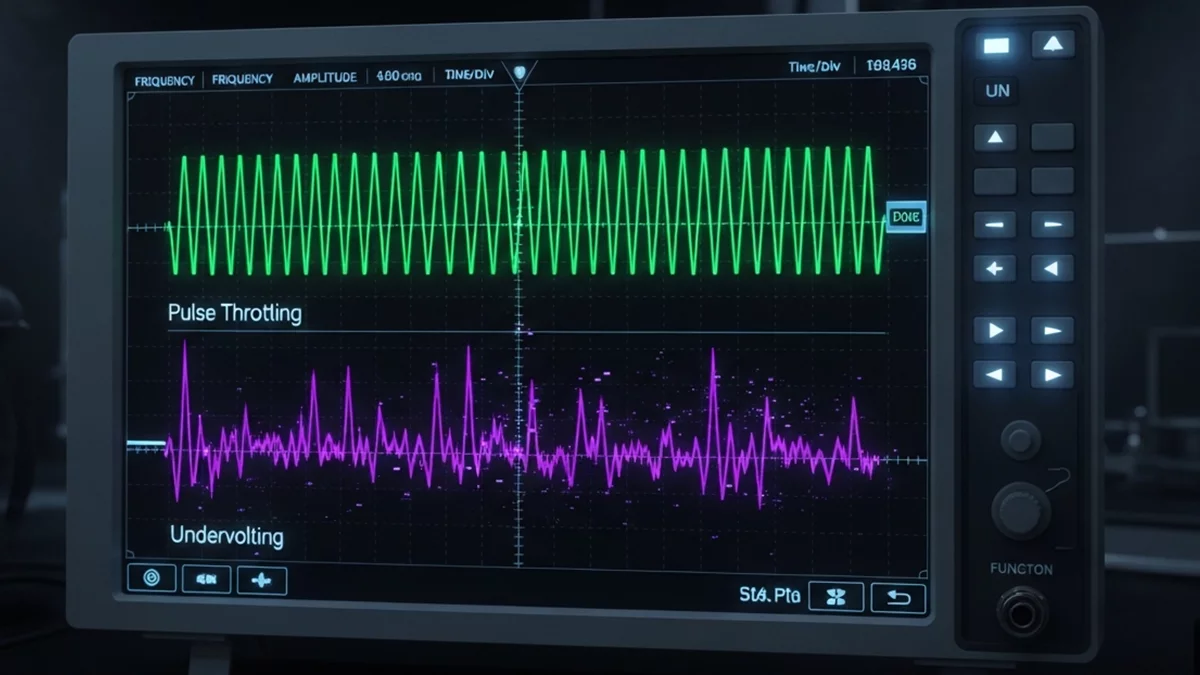
Unlike undervolting, Pulse Throttling is 100% reversible and hardware-agnostic. There is no risk of a "bad flash" or permanent instability. The benefits include:
- No Crashes: Since we don't lower the voltage below stable limits, the GPU remains 100% stable.
- Predictive Management: VRAM Shield monitors the rate of temperature increase, not just the current value.
- Ease of Use: No need to spend hours stress-testing curves; VRAM Shield handles the pulses for you.
Pulse Throttling is a stable and intelligent path for professionals. Ready for a smarter way to manage thermals? Explore our PRO features and take control of your thermal destiny.