Quick Summary
Understanding the intricacies of gaming laptop thermal design is essential for any modern power user. Unlike desktops, laptops must cram high-performance components into extremely thin chassis, leading to unique engineering trade-offs.
The Shared Cooling Trap
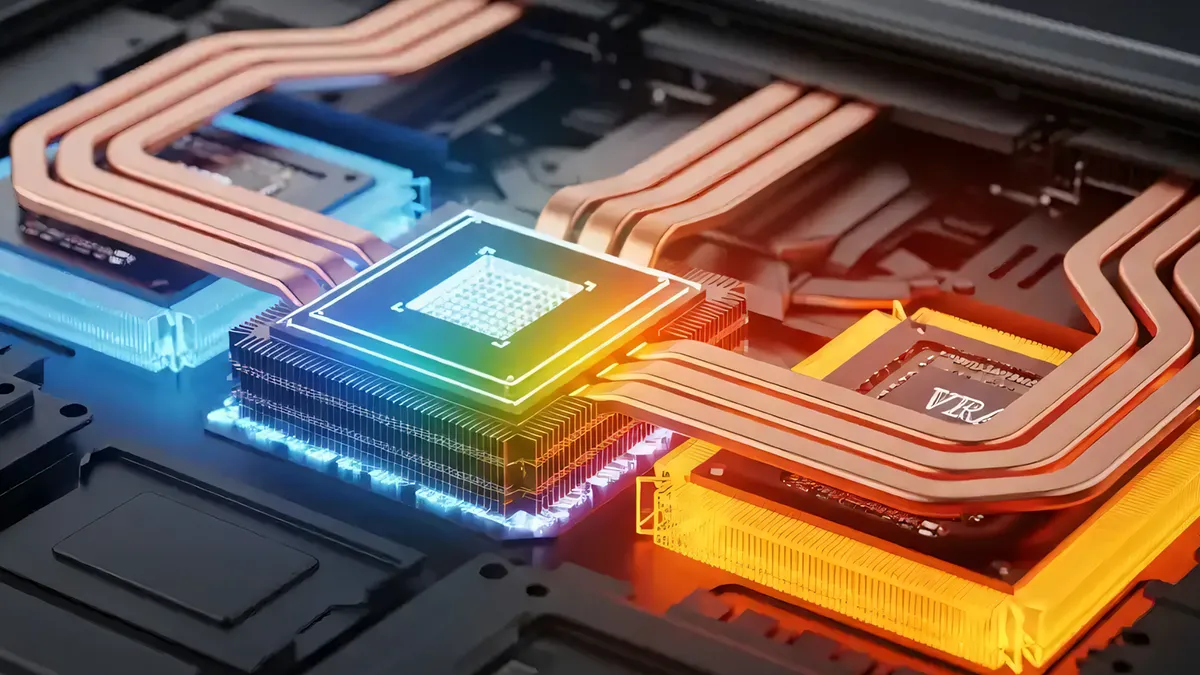
Most modern machines utilize a shared heat pipe architecture to save space and weight. This design connects the CPU and GPU to the same cooling assembly, creating a single thermal loop.
While cost-effective, this approach often leads to a significant thermal bottleneck laptop users face during heavy compute sessions. When both processors are active, the copper pipes reach their maximum heat-carrying capacity almost instantly. This thermal saturation prevents secondary components, like memory modules, from venting their energy into the primary cooling stream, leading to localized heat accumulation that compromises the entire system's stability.
The challenge becomes even more pronounced during AI generation VRAM workloads. Unlike gaming, which allows for brief cooling gaps, AI inference keeps the memory chips at peak power for hours on end.
This sustained activity is a primary cause of laptop VRAM overheating in professional mobile workstations. Without the natural breaks found in rasterized rendering, the heat soak becomes a persistent threat to performance.
Owners of flagship devices often monitor their RTX 4080 laptop temps using standard software overlays. Unfortunately, these tools usually only report the temperature of the main GPU core. This provides a false sense of security, as the memory chips sitting millimeters away could be operating at temperatures 30°C higher than the core, completely hidden from the user's view until the performance drops.
The extreme GDDR6X heat density found in modern laptops requires a more specialized cooling strategy. These high-speed modules generate massive amounts of thermal energy within a very small surface area.
Without granular VRAM temperature control, your system is essentially flying blind. Standard fan curves are rarely aggressive enough to protect the memory junction from reaching its critical physical limits during rendering.
"By the time the firmware detects a crisis, it is often too late to prevent a hard, performance-killing throttle that disrupts your creative or technical workflow and doubles your render times."
To achieve consistent performance across long projects, you must look beyond the physical cooling assembly. Even the best fans cannot overcome the laws of thermodynamics when a shared heat pipe is fully saturated. By the time the firmware detects a crisis, it is often too late to prevent a hard, performance-killing throttle that disrupts your creative or technical workflow and doubles your render times.
Adopting Memory Junction temperature monitoring 2026 standards is the first step toward professional stability. Knowing the real-time thermal state of your memory allows you to make informed management decisions.
When the system reaches thermal saturation, the hardware can no longer move heat effectively. At this point, even the highest fan speeds provide diminishing returns for the memory modules.
At this critical juncture, the VBIOS usually triggers a reactive thermal emergency protocol. This survival mechanism slashes clock speeds to prevent permanent silicon damage, but it also causes your frame rates or render speeds to fall off a cliff. This erratic behavior is a nightmare for professionals who need predictable results and stable system behavior to meet their difficult project deadlines.

Know your VRAM Thermal Limits
Download the 2026 Reference Chart for RTX 30/40/50 Series.
Software-Defined Thermal Management
VRAM Shield offers a proactive alternative to these blunt firmware-level fixes. It provides the granular oversight needed to manage your hardware's thermal profile at the operating system level.
The utility utilizes proprietary Pulse Throttling technology to manage high-intensity workloads. This method introduces millisecond-long micro-suspensions that give the cooling assembly a brief moment to breathe and dissipate heat.
This intelligent approach to process scheduling VRAM is far more effective than global power capping. By targeting only the specific process causing the thermal load, the rest of your system remains perfectly responsive. It allows the shared heat pipes to clear the thermal soak from the junction modules before they reach the critical threshold that triggers a hard and uncoordinated firmware throttle. For those who require absolute precision, the PRO version includes Smart Throttling capabilities. This feature uses a PID-controller to find the perfect balance between cooling efficiency and computational throughput.
Prioritizing hardware longevity is essential in an era where high-end components are increasingly expensive. Protecting your memory from excessive heat cycles is the best way to safeguard your investment.
Ultimately, taking control of your thermal environment ensures that your workstation remains a reliable tool for your professional growth. By bridging the gap between hardware physics and software management, you can achieve the stability your most demanding projects require. Consistent results are the hallmark of a professional setup, and managing your VRAM heat is the foundation of that long-term reliability for any workstation.
Don't let unmanaged heat compromise your system's stability or performance. Take direct, professional control over your hardware's thermal performance today. Secure your workflow stability and safeguard your hardware by choosing your VRAM Shield plan today.